

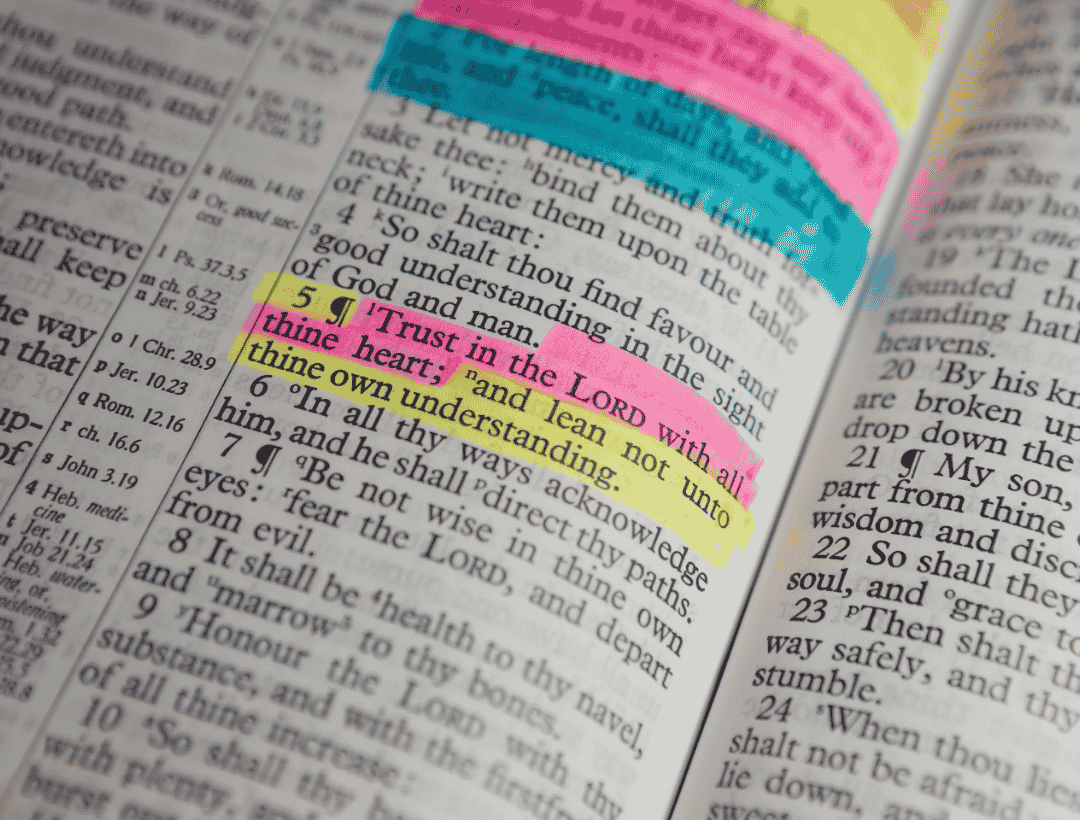
Quick answer: No English translation wins every reading goal. Choose a respected translation that fits your reading level and purpose, then compare two or three versions when a passage is difficult.
Every translation makes informed choices between preserving source-language form and communicating meaning in natural English. “Word-for-word” and “thought-for-thought” are useful shorthand, not complete scientific rankings.
Choose your starting point
- I am reading the Bible for the first time: Try NLT or NIV
- I want balanced everyday reading and study: Try NIV or CSB
- I want closer-form comparison: Try ESV or NASB
- I need academic/ecumenical use: Try NRSVue
- I value historic English cadence: Compare NKJV and KJV
Ask these four questions first
- Am I reading for the first time, studying closely, reading aloud, or memorizing?
- Do I understand the English without constantly stopping?
- What translation does my church or study group use?
- Will I compare another respected version when wording affects interpretation?
Catholic, Orthodox, and Protestant Bibles may also differ in canon and book arrangement. A study Bible is a translation plus human notes; the notes are not the biblical text.
Resources worth opening
1. NLT · New Living Translation
Best for: First-time reading, listening, and immediate clarity · Format: Translation Profile · Access: Free · Time: Quick profile
Meaning-focused choices can make interpretation less visible to the reader.
2. NIV · New International Version
Best for: Balanced everyday reading, church use, and general study · Format: Translation Profile · Access: Free · Time: Quick profile
Balances source form with natural modern English.
3. CSB · Christian Standard Bible
Best for: Modern readability with a closer-form study feel · Format: Translation Profile · Access: Free · Time: Quick profile
“Optimal equivalence” is the publisher’s framework, not an objective score.
4. ESV · English Standard Version
Best for: Close-form study, literary reading, and memorization · Format: Translation Profile · Access: Free · Time: Quick profile
Its wording and notes reflect an evangelical editorial tradition.
5. NASB · New American Standard Bible
Best for: Detailed close-form comparison and word-focused study · Format: Translation Profile · Access: Free · Time: Quick profile
Natural English can sometimes be secondary to preserving source structure.
6. NRSVue · New Revised Standard Version Updated Edition
Best for: Academic, ecumenical, classroom, and inclusive-language use · Format: Translation Profile · Access: Free · Time: Quick profile
Some churches prefer a different approach to gender language or canon.
7. NKJV · New King James Version
Best for: Familiar KJV cadence with substantially modernized English · Format: Translation Profile · Access: Free · Time: Quick profile
Retains close connections to the KJV’s textual and literary tradition.
8. KJV · King James Version
Best for: Literary heritage, historical study, and communities that use it liturgically · Format: Translation Profile · Access: Free · Time: Quick profile
Archaic English and an older manuscript base can obscure meaning for modern readers.
9. Bible Gateway Version Library
Best for: Browsing and comparing translations · Format: Bible Tool · Access: Free · Time: As needed
Browse version profiles, then place two or three translations beside the same passage.
Try this simple path
- Choose one passage you already understand.
- Open it in three candidate translations.
- Read each aloud and notice clarity, rhythm, and differences.
- Choose one primary reading Bible and keep a second translation for comparison.
Questions people ask
Is a paraphrase the same as a translation?
Paraphrases restate meaning more freely and can be useful for fresh reading, but they make interpretive choices more visible. For careful study, compare them with a committee translation.
Why do translations use different words?
Ancient words have ranges of meaning, grammar differs between languages, manuscripts have variants, and translation teams make different judgments about clarity, style, and context.
Share this guide
Save the four-question chooser and send it to someone buying their first Bible.
On His Way shares these resources for discovery and education. Inclusion does not mean agreement with every view expressed. Compare teaching with Scripture and seek wisdom in a faithful local church.
Links last reviewed 2026-08-18. Availability, pricing, and schedules can change; confirm details on the official destination.

.jpg)


.jpg)
.jpg)